


Molecules As Graphs
The reason a laptop can search a billion-compound library, plan a synthesis, or flag a structural alert in milliseconds is that we represent molecules as graphs — atoms as nodes, bonds as edges — and chemical questions as graph algorithms. That abstraction is what makes the field tractable. It is also the source of its most subtle and most expensive failures.

The Personal Pharmacology of Sports Nutrition: Why Caffeine, Beetroot, and Creatine Work for Some Athletes and Not Others
The frontier of sports nutrition is not a more sophisticated genetic test. It is the slow, unglamorous work of treating each athlete as a biochemically distinct individual, paying attention to what actually changes when something is tried, and discarding what does not work without ceremony. The molecular understanding now exists to explain why two cyclists who train together can take the same caffeine pill and produce opposite results.

From Biological Systems to Human Performance: How ML Pipelines Built for Genomics Transfer to Sports Science
A quiet convergence is happening between computational biology and sports performance science. On one hand, bioinformatics labs routinely build machine learning pipelines that ingest high-dimensional biological data and extract predictive features that explain complex physiological processes. On the other hand, sports science teams are drowning in multivariate time series from wearables, force plates, metabolic carts, and GPS trackers, and they need exactly the same thing: models that take noisy biological signals and predict outcomes that matter.
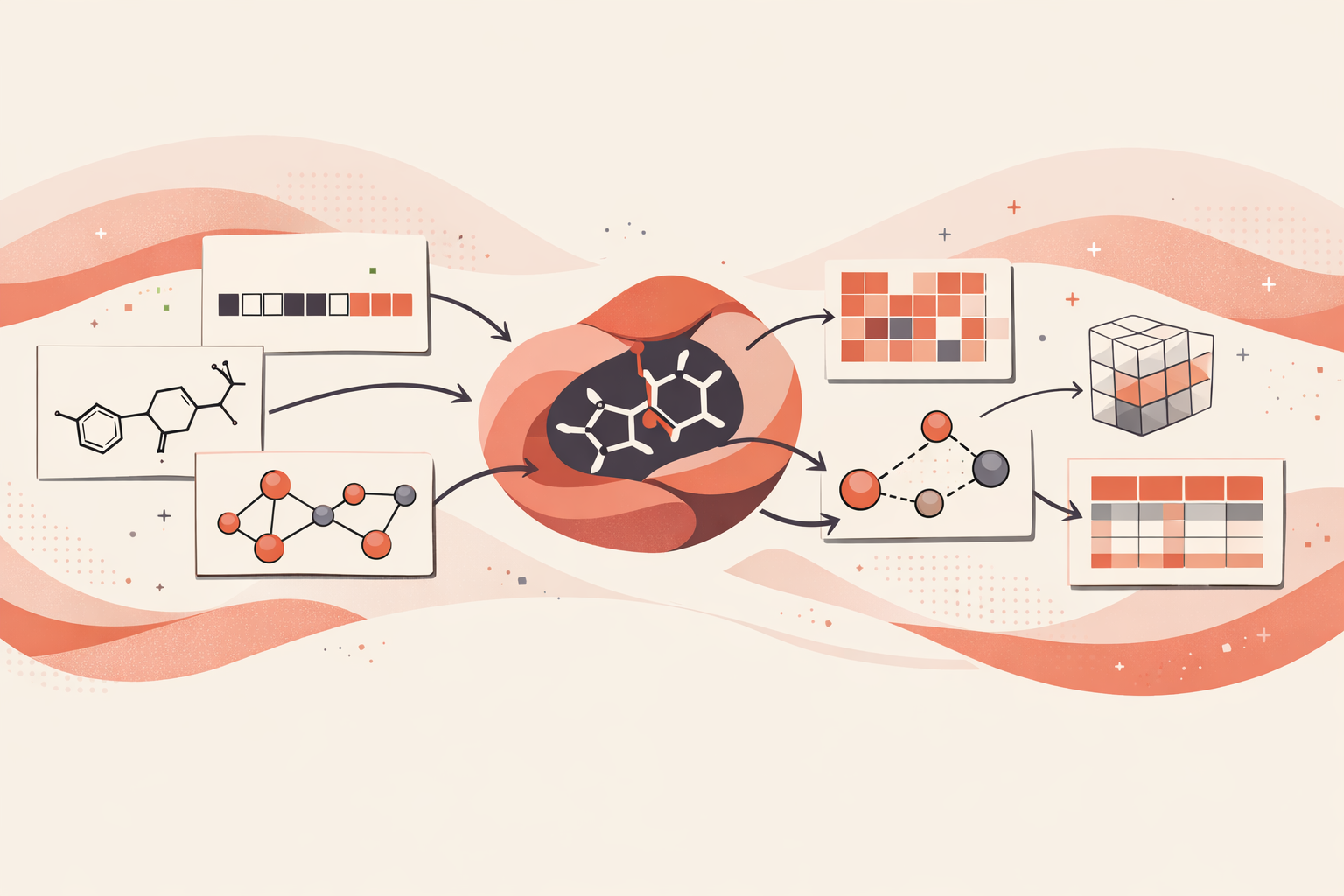
Representing Molecular Interaction Data: From Crystal Structures to Learned Embeddings
A scientist encountering molecular interaction data for the first time confronts a landscape of representations that can feel arbitrary: why does one paper use contact maps, another use SPLIF, a third use equivariant graph networks? The answer, almost always, is that each author chose the representation whose information content matched the task and whose compute profile fit the available hardware. Understanding what each representation encodes, and what it quietly lets fall away, is the difference between picking the right tool and reaching for whatever happens to be closest.

Uncertainty Quantification in Molecular Property Prediction: From Research Metric to Deployment Requirement
A model that returns a prediction for every molecule submitted to it, regardless of whether that molecule is within its training domain, is not a helpful model. It is a model that has traded honesty for convenience. In pharmaceutical ML, where predictions influence synthesis queues, compound prioritization, and program-level strategy, a crisp prediction for a molecule the model knows nothing about is worse than no prediction at all..

The Molecular Engineering Layer in Precision Oncology: From Actionable Target to Clinical Candidate
The precision oncology infrastructure — the sequencing, the molecular tumor boards, the platform trials — is built. It is waiting for molecules. The rate at which it can deliver therapeutic benefit to patients is gated by the rate at which molecular engineering can produce clinical candidates for the targets that profiling identifies. For the majority of actionable oncology targets, that rate is not fast enough, and resistance narrows the window further with each month of treatment.

Building the Data Foundation: Data Engineering Patterns for Molecular and Genomic ML in Pharma
The convergence of chemical and biological data in pharmaceutical ML is accelerating. Foundation models trained simultaneously on molecular structures, protein sequences, and genomic data demand even more rigorous data engineering — consistent molecular representations, reliable cross-modal entity resolution, and auditable provenance across data types that were never designed to interoperate. Organizations that invest in their data foundation now, treating molecular data engineering as infrastructure rather than scripting, will be positioned to adopt these capabilities as they mature.

Ten Essential Practices for Building Sustainable ML Systems in Pharma
In pharmaceutical ML, unlike consumer technology, your systems may need to justify decisions made today for decades to come. A model supporting an IND filing in 2024 may face scrutiny in patent litigation in 2034 or regulatory audit in 2029. Investing in sustainability is not optional—it is professional responsibility.

Developing Customizable Machine Learning Pipelines: A Systems-First Approach to Reliability and Trust
Machine learning models come and go, superseded by improved architectures, better data, or changing business requirements. Pipelines persist. They outlive individual models, span multiple projects, survive personnel changes, and adapt to shifting research questions. When treated as first-class systems rather than incidental scaffolding, pipelines transform from sources of fragility into foundations for sustainable AI capability.

Common Failure Modes in Pathogen Genomics Machine Learning Pipelines: Lessons for AMR, Fungal and Viral Drug Discovery
Machine learning (ML) promises transformative gains in pathogen genomics — from antimicrobial resistance (AMR) prediction to fungal target identification and rapid viral variant characterization. Yet, across research and translational environments, pipelines that integrate high-throughput sequencing with ML models regularly fail to deliver robust, generalizable outcomes.


Have something you’d like to submit to The Commons?
Send us your name and email, and we’ll send you a follow-up with further details regarding the submission process.